Showcases Scientific Progress Across Europe
14 July 2026 | University of Udine, Italy
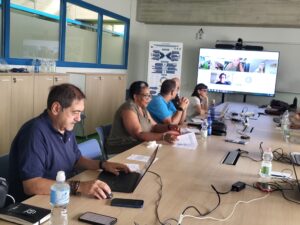
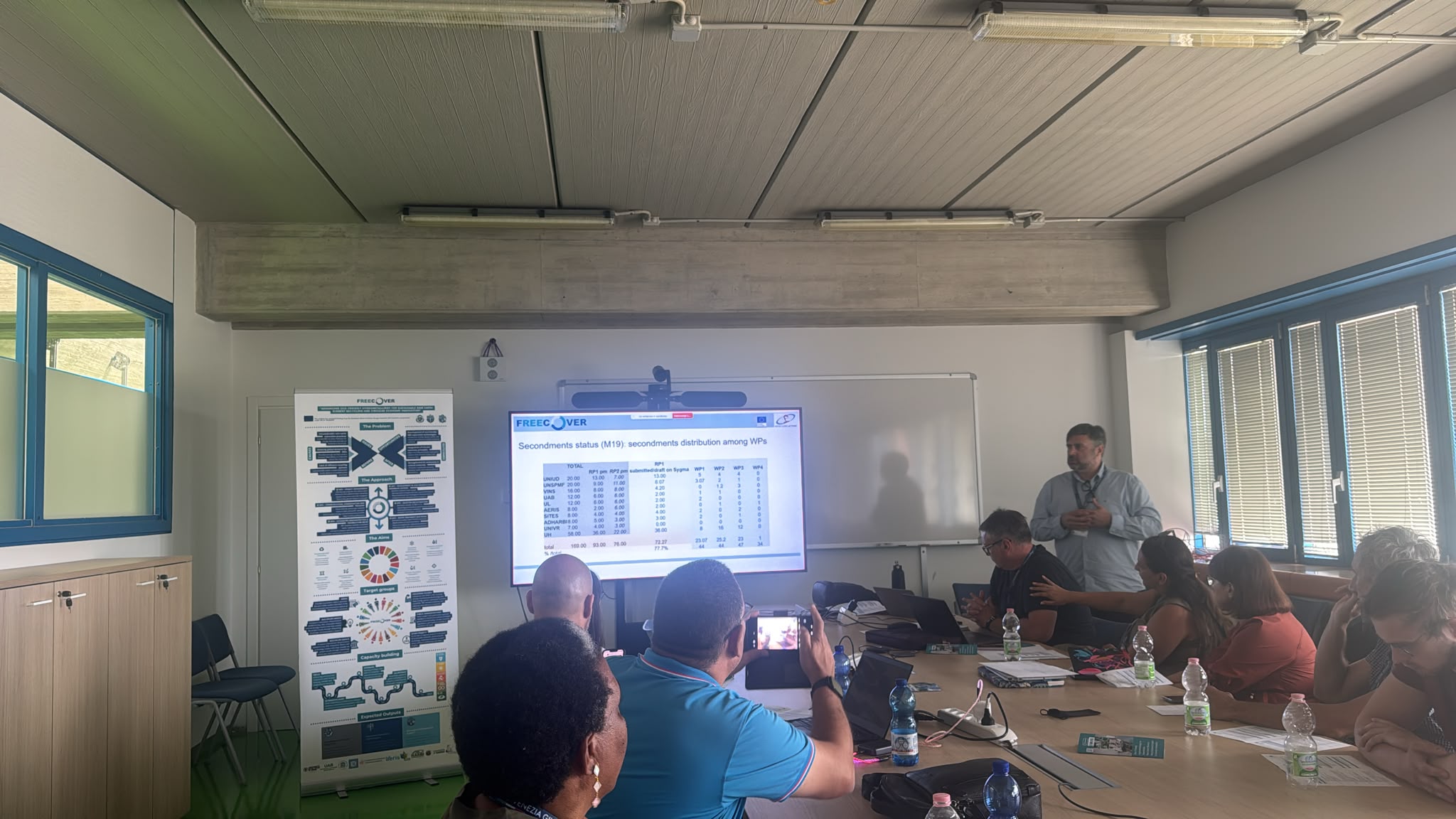
The FREECOVER consortium successfully held its Mid-Term Meeting (M18) on 14 July 2026 at the University of Udine (UNIUD), Italy, bringing together project partners to review scientific achievements, evaluate progress across all Work Packages (WPs), and strengthen collaboration within the Horizon Europe MSCA Staff Exchanges programme. The meeting provided an important opportunity to assess research developments, share secondment experiences, discuss project management and dissemination activities, and define the next steps toward sustainable Rare Earth Element (REE) recovery technologies.
Hosted by Università degli Studi di Udine, the event welcomed representatives from universities, research institutes, SMEs and associated partners across Europe and Cuba, reflecting the project’s strong interdisciplinary and international collaboration network.
Opening the Mid-Term Meeting
The meeting began with a welcome session led by Prof. Andrea Melchior, Project Coordinator from the University of Udine (UNIUD), who introduced the consortium partners and highlighted the objectives of the Mid-Term Meeting.
The session emphasized the project’s excellent progress during its first eighteen months, the importance of staff exchanges in fostering scientific collaboration, and FREECOVER’s contribution to developing environmentally friendly hydrometallurgical technologies for the recovery of Rare Earth Elements (REEs).
WP1 – Development of Novel Eco-Friendly Ionic Liquids and Integration with Supporting Materials
The first scientific session was presented by Prof. Slobodan Gadžurić from the University of Novi Sad – Faculty of Sciences (UNSPMF), Serbia, leader of Work Package 1.
Prof. Gadžurić presented the latest achievements in the design and synthesis of environmentally friendly ionic liquids and the development of Supported Ionic Liquid Membranes (SILMs), two key technologies underpinning FREECOVER’s innovative hydrometallurgical approach.
The presentation demonstrated the progress achieved in creating sustainable extraction media capable of improving Rare Earth Element recovery while reducing environmental impacts compared with conventional extraction processes.
The session also highlighted the close collaboration between UNSPMF and partners from UNIUD, the University of Ljubljana (UL), the University of Havana (UH), and ADHARBI, illustrating how international cooperation is accelerating scientific innovation across the consortium.
WP2 – Selective Extraction of Rare Earth Elements
The second session was delivered by Prof. Tatjana Trtić-Petrović from the Vinča Institute of Nuclear Sciences (VINS), Serbia, leader of Work Package 2.
Her presentation focused on advances in selective extraction technologies for Rare Earth Elements using ionic liquids and Supported Ionic Liquid Membranes.
The audience was introduced to recent developments in REE solution speciation, environmentally friendly leaching strategies, liquid-liquid extraction methodologies, and membrane-based separation systems that aim to improve recovery efficiency while supporting circular economy principles.
The work presented represents a collaborative effort involving researchers from VINS, UNIUD, UAB, UNSPMF, UL, UNIVR, SITES, and the University of Havana, demonstrating the highly integrated nature of FREECOVER research activities.
WP3 – Water Treatment and Recycling Using Natural Adsorbents
Progress on Work Package 3 was presented by Prof. Montserrat Lopez-Mesas from the Universitat Autònoma de Barcelona (UAB), Spain.
Her presentation showcased the development of innovative natural adsorbent materials designed to recover valuable elements while simultaneously treating industrial wastewater.
The session highlighted advances in material preparation, characterization, adsorption studies, and the reuse of adsorbents as catalysts within Advanced Oxidation Processes (AOPs).
These activities contribute directly to FREECOVER’s ambition of integrating sustainable water treatment into environmentally responsible REE recovery processes while strengthening collaboration among UAB, UNIUD, UNSPMF, VINS, ADHARBI, SITES, and UH.
WP4 – Integrated Process for REE Recovery, Transition Metal Removal and Water Recycling
The fourth technical session was presented by Dr. Óscar Jesús Prado Rubianes from AERIS Tecnologías Ambientales (AERIS), Spain, leader of Work Package 4.
The presentation focused on integrating the technologies developed throughout the project into a comprehensive pilot-scale process capable of recovering Rare Earth Elements, removing transition metals, and recycling process water.
Updates included the design of adsorption modules, membrane-based separation systems, scalability studies, Life Cycle Assessment (LCA), economic feasibility analysis, and stakeholder engagement activities supporting future industrial implementation.
The session illustrated how FREECOVER is progressing from laboratory-scale research towards practical and sustainable technological solutions.
WP5 – Communication, Dissemination and Civil Society Engagement
Communication activities were presented by Dr. Leonardo Piccinetti, CEO of Sustainable Innovation Technology Services Ltd (SITES), Ireland, leader of Work Package 5.
The presentation reviewed the project’s dissemination achievements during the reporting period, including website development, newsletters, press releases, scientific event promotion, social media communication, dissemination of secondments, and stakeholder engagement.
Particular emphasis was placed on strengthening FREECOVER’s visibility within the scientific community and among wider audiences through professional communication aligned with Horizon Europe requirements.
The presentation also highlighted how communication activities have supported knowledge transfer, promoted project achievements, and increased awareness of sustainable Rare Earth Element recovery technologies.
WP6 – Project Management
The management session was delivered by Prof. Andrea Melchior, Project Coordinator from the University of Udine (UNIUD).
Knowledge Transfer Through MSCA Staff Exchanges
A dedicated session focused on the impact of the MSCA Staff Exchanges programme within FREECOVER.
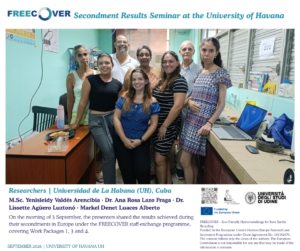
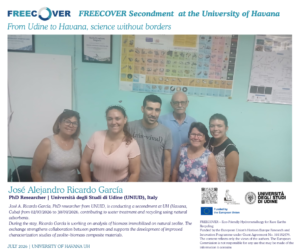
Partners reviewed secondment implementation against the project plan, highlighting how researcher mobility has accelerated scientific collaboration, enabled knowledge transfer between institutions, strengthened laboratory skills, and supported long-term international cooperation.
Several secondees presented their research experiences, demonstrating the scientific and professional benefits generated through mobility across the consortium.
These presentations illustrated how staff exchanges remain one of FREECOVER’s most valuable mechanisms for building research capacity and developing future scientific leaders.
Looking Ahead
The Mid-Term Meeting confirmed that FREECOVER is making strong progress towards its scientific and dissemination objectives. The close integration of research, secondments, communication, and project management demonstrates the consortium’s commitment to delivering innovative and sustainable solutions for Rare Earth Element recovery.
As the project enters its next phase, partners will continue advancing eco-friendly hydrometallurgical technologies, strengthening international collaboration, and expanding the impact of FREECOVER through scientific excellence, knowledge exchange, and effective dissemination in support of Europe’s circular economy and critical raw materials strategy.