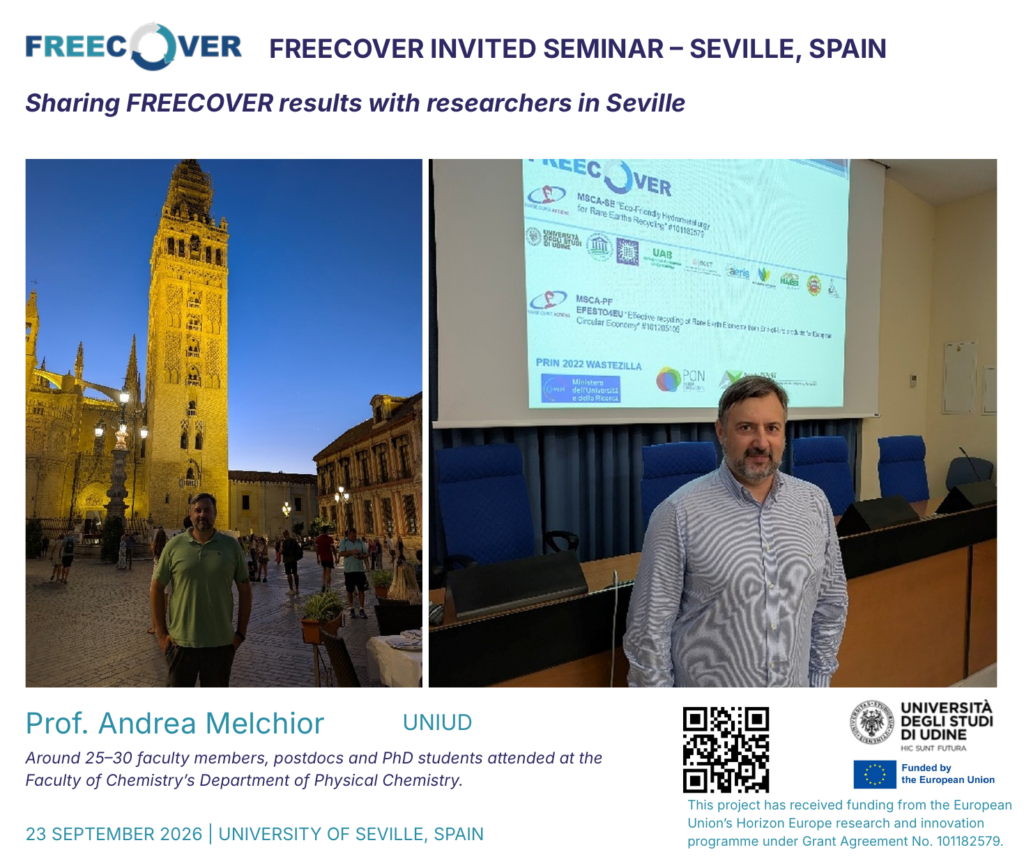
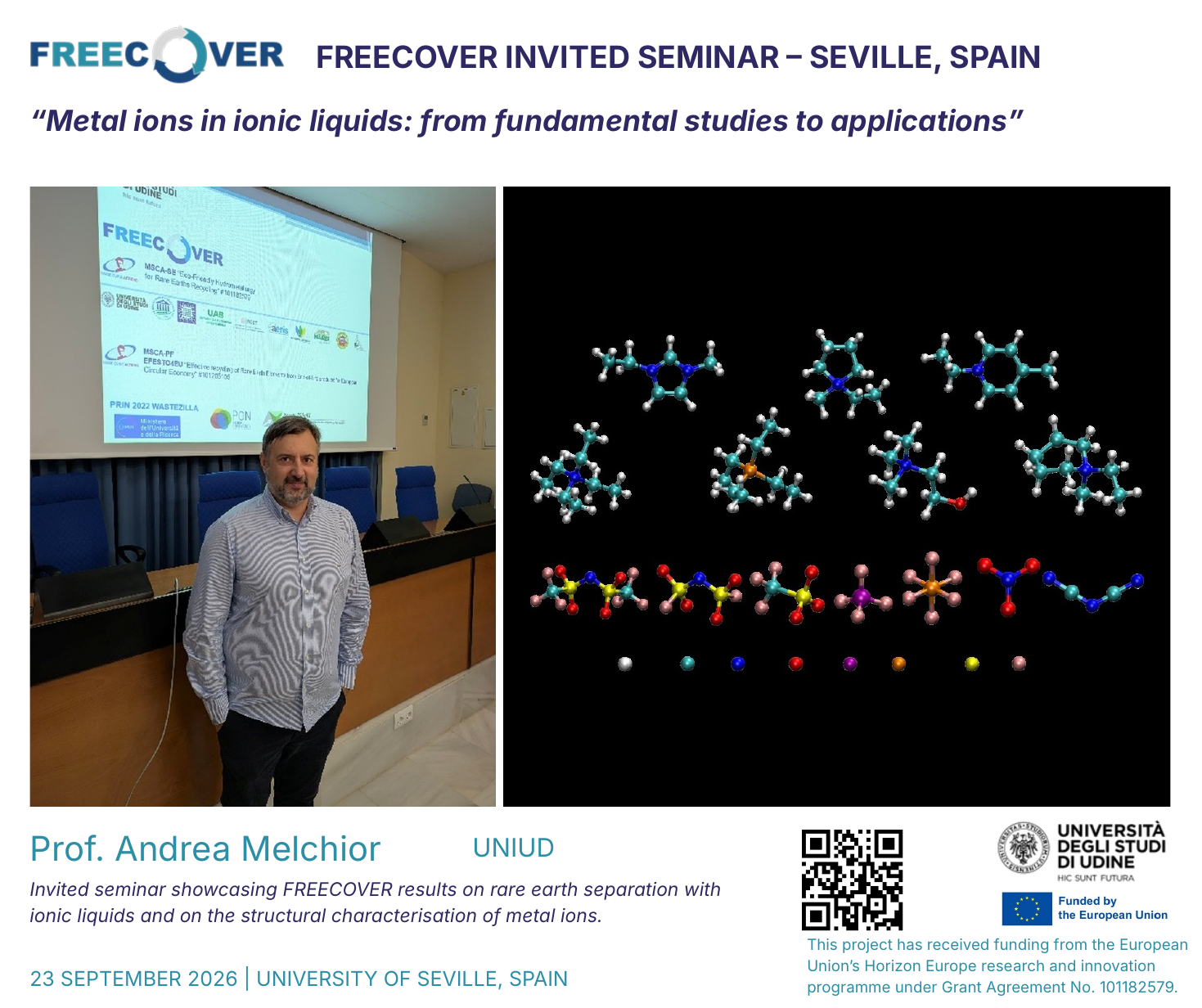
Project Coordinator Prof. Andrea Melchior shares FREECOVER results on rare earth separation with researchers in Spain
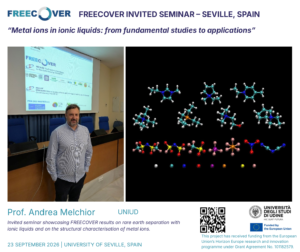
On 23 September 2026, FREECOVER Project Coordinator Prof. Andrea Melchior (University of Udine) gave an invited seminar at the University of Seville, Spain. The seminar took place in the “Sala de Grados” of the Department of Physical Chemistry, Faculty of Chemistry.
Entitled “Metal ions in ionic liquids: from fundamental studies to applications”, the seminar showcased FREECOVER results, especially on the separation of rare earth elements (REEs) with ionic liquids and on structural characterisation. Around 25–30 people attended, mostly faculty members, postdoctoral researchers and PhD students.
Why ionic liquids?
Ionic liquids are salts that stay liquid below 100 °C. They have negligible volatility, do not burn easily and are thermally and electrochemically stable. These properties make them promising “green” alternatives to volatile organic solvents in the hydrometallurgical recovery of critical raw materials from mining activity and end-of-life devices.
From fundamental studies…
To design efficient separation processes, researchers need to know which species metal ions form in an ionic liquid, how stable they are and what structure they have. Prof. Melchior presented recent studies on how metal ions such as cobalt, zinc and silver are coordinated and solvated in common ionic liquids based on imidazolium and phosphonium cations. The work combines spectroscopic and thermodynamic techniques with quantum chemical calculations and molecular dynamics simulations.
to applications
The seminar closed with case studies on extracting cobalt and rare earth elements from aqueous solutions. This links directly to FREECOVER, where eco-friendly ionic liquids supported on polymer membranes are used to recover rare earth elements from end-of-life permanent magnets.
Events like this help FREECOVER share its results beyond the consortium and build new connections with the European research community.
FREECOVER has received funding from the European Union’s Horizon Europe research and innovation programme under the Marie Skłodowska-Curie grant agreement No. 101182579. Views and opinions expressed are those of the author(s) only and do not necessarily reflect those of the European Union or the European Research Executive Agency. Neither the European Union nor the granting authority can be held responsible for them.