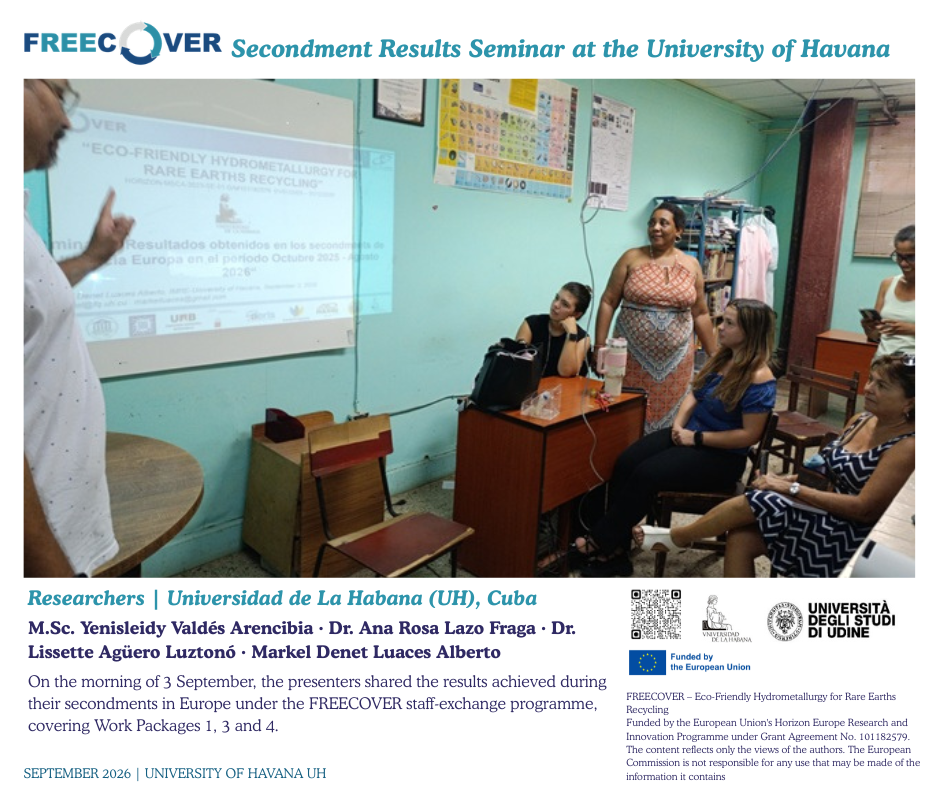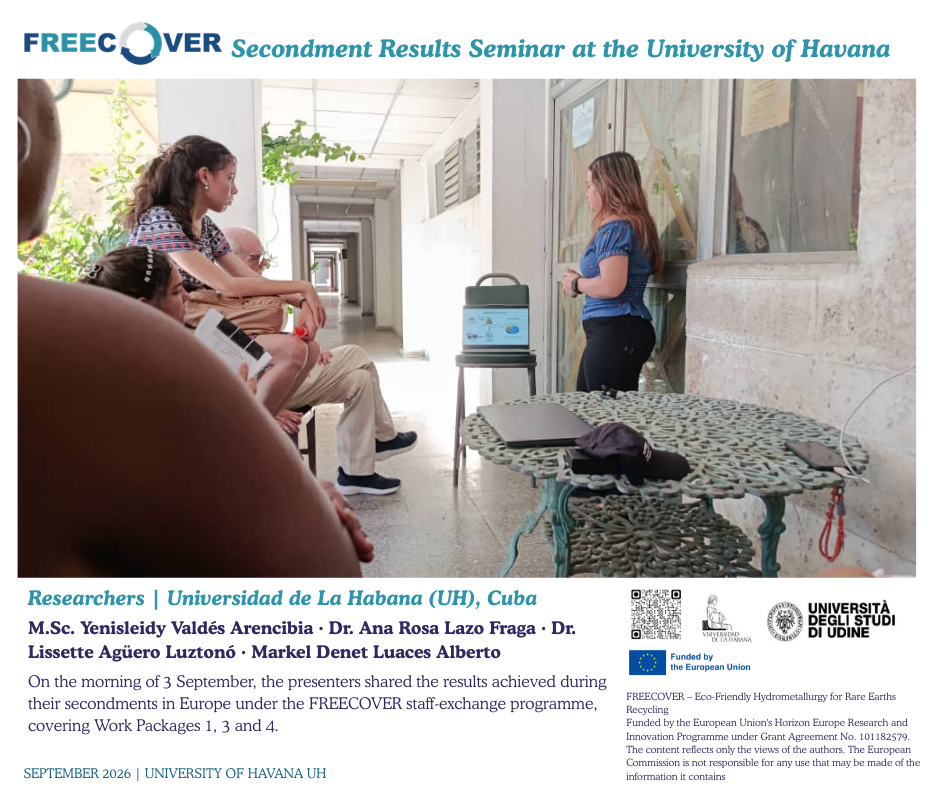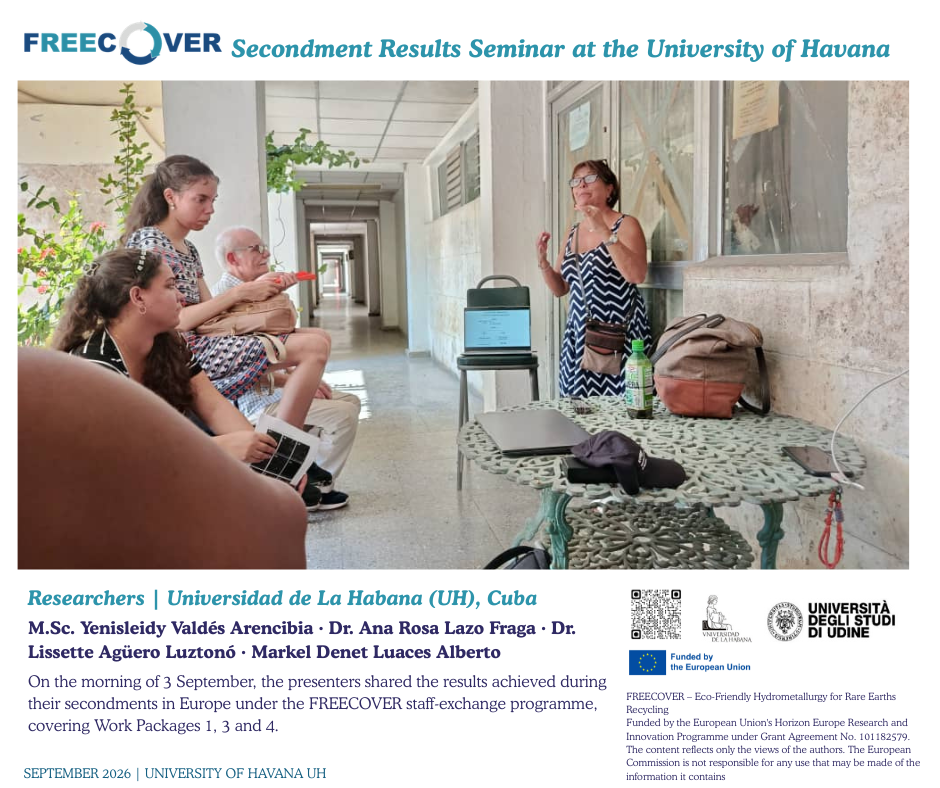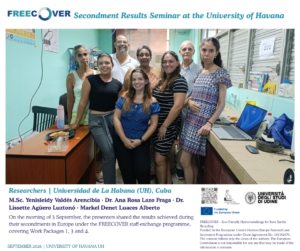
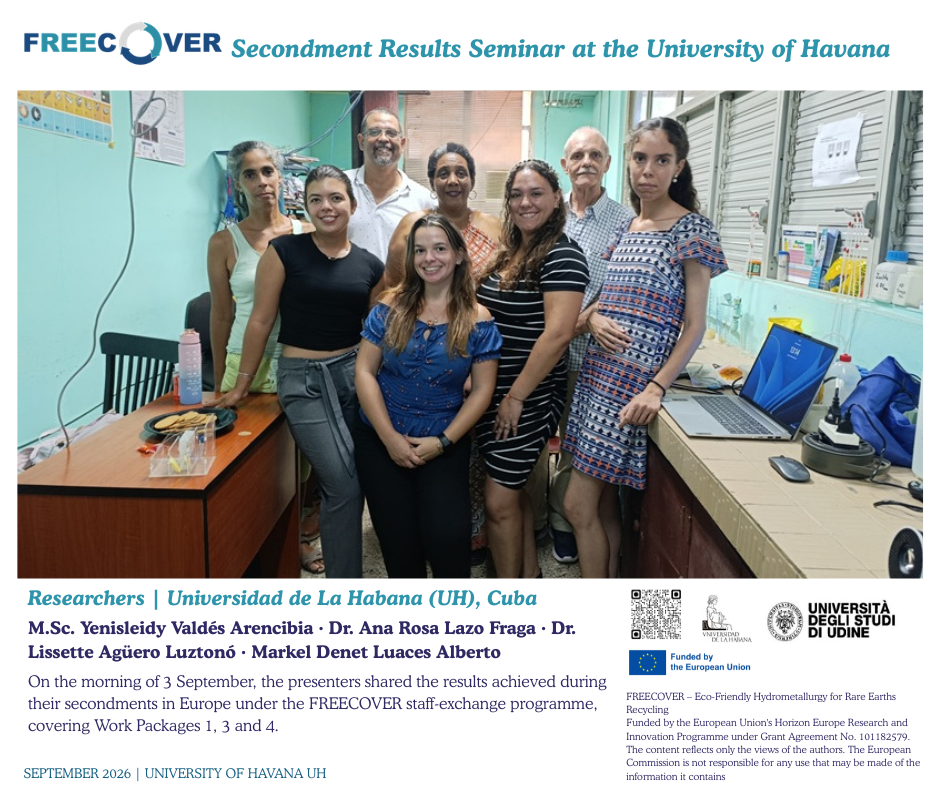
On the morning of 3 September, the University of Havana (UH) hosted a seminar to review the results achieved during its researchers’ secondments in Europe between October 2025 and August 2026, carried out under the FREECOVER project.
M.Sc. Yenisleidy Valdés Arencibia and Drs. Ana Rosa Lazo Fraga, Lissette Agüero Luztonó and Markel Denet Luaces Alberto presented the outcomes of their work across Work Packages 1, 3 and 4, developed at the partner institutions leading each package: the University of Novi Sad Faculty of Sciences (Serbia), the Universitat Autònoma de Barcelona and AERIS Tecnologías Ambientales (both Spain).
Their secondments contributed directly to FREECOVER’s core objectives: developing eco-friendly ionic liquids, advancing water treatment and recycling with natural adsorbents such as Cuban zeolite, and integrating these steps into a sustainable process for recovering rare earth elements from metallic waste.
The seminar reflects the added value of the Horizon Europe Marie Skłodowska-Curie Staff Exchange scheme, through which UH, as FREECOVER’s associated partner from Cuba, exchanges knowledge and expertise with the project’s European partners, strengthening EU–Cuba scientific cooperation and building lasting research capacity in Havana.
FREECOVER continues to advance eco-friendly hydrometallurgy for sustainable rare earth element recycling and circular economy innovation.
FREECOVER – Eco-Friendly Hydrometallurgy for Rare Earths Recycling. Funded by the European Union’s Horizon Europe Research and Innovation Programme under Grant Agreement No. 101182579. Views expressed are those of the authors only; the European Commission is not responsible for any use made of this information.